
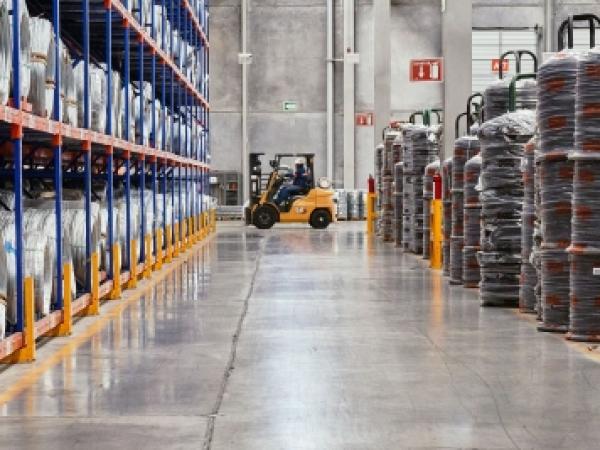
Workplace transport covers vehicles and mobile equipment used in work settings, including activities such as vehicle movements, loading, unloading and manoeuvring. Employers in Great Britain should assess these risks around three connected areas: the site, the vehicle and the driver.
Separate Vehicles and Pedestrians Wherever Possible
Site design is one of the main controls for workplace transport risk. Traffic routes should be planned so that pedestrians and vehicles can move without unnecessary interaction, with physical separation used wherever reasonably practicable.
Separate pedestrian and vehicle routes are preferable. Pedestrian walkways, suitable crossing points and barriers can help prevent people entering vehicle operating areas. Entrances and exits should also be considered so that people do not have to step directly into traffic routes.
Where the workplace allows it, one-way vehicle systems can reduce reversing and make traffic movements easier to manage. Visibility at junctions, crossings and areas where vehicles manoeuvre should also be considered as part of the site assessment.
Control Reversing and Other Vehicle Movements
Reversing creates particular difficulties because drivers may have restricted visibility. Site arrangements should therefore seek to reduce the need for reversing before relying on drivers or pedestrians to manage the interaction.
Where reversing cannot be avoided, the assessment should consider the layout, visibility and movement of people in the area. Excluding pedestrians from reversing zones and organising vehicle movements so that manoeuvres take place in controlled areas can reduce exposure.
Managers should also assess activities such as parking, coupling and uncoupling, tipping and vehicle movement around loading areas. These tasks should form part of the workplace transport risk assessment rather than being treated as routine driving.
Manage Loading and Unloading Areas as Workplaces
Loading and unloading brings vehicles, workers, visiting drivers and handling operations together. The area should therefore be planned and managed as part of the site's transport arrangements.
Employers should consider where vehicles will stop, how people will move around them and whether other traffic can enter the area during loading. The condition and suitability of the loading location also form part of the assessment.
Visiting vehicles require management as well as vehicles owned by the organisation. Where deliveries or collections involve another business, arrangements should make responsibilities clear and provide drivers with the information they need to operate safely on the site.
Provide Vehicles That Are Suitable and Maintained
The vehicle must be appropriate for the task and the environment in which it will operate. Selection should take account of the work being carried out, site conditions and the people who will use the vehicle.
Vehicles also need maintenance arrangements that keep them safe for use. Employers should have a system for identifying defects and making sure that problems affecting safety are dealt with.
Changes to vehicles, equipment or operating conditions should prompt consideration of whether existing controls remain suitable. A vehicle that works safely in one area or for one task should not automatically be assumed suitable for another.
Confirm Driver Competence and Safe Behaviour
Drivers need to be able to operate the vehicles and equipment assigned to them safely. Selection, information, instruction, training and supervision should reflect the work they perform.
Competence should be considered alongside behaviour. Site rules, speed controls, pedestrian arrangements and defined traffic routes are less effective if they are routinely ignored.
Supervisors should therefore observe how vehicles are actually being operated. Unsafe shortcuts, distraction or repeated departures from agreed routes should be addressed through the management arrangements rather than accepted as normal site practice.
Common Compliance Gaps
Workplace transport weaknesses often arise when pedestrian routes exist only as painted lines but are routinely crossed by vehicles, reversing remains common despite opportunities to redesign traffic flow, or loading areas allow uncontrolled pedestrian access.
Other problems include unclear rules for visiting drivers, unsuitable vehicles being used for particular tasks, poor defect management and training records that do not establish whether drivers remain capable of carrying out the work safely.
Manager Checklist
- Review workplace transport risks under the headings of safe site, safe vehicle and safe driver.
- Check whether pedestrians and vehicles can be physically separated on regular routes.
- Identify where reversing occurs and whether the need for it can be reduced.
- Examine loading, unloading and parking areas for uncontrolled vehicle-pedestrian interaction.
- Confirm vehicles are suitable for their tasks and subject to effective maintenance arrangements.
- Verify that drivers have the competence needed for the vehicles and activities assigned to them.
- Check how visiting drivers receive site rules and information.
- Observe actual vehicle movements to confirm that planned controls are being followed.
FAQ
What counts as workplace transport?
It includes vehicles and mobile equipment used in a work setting. Vehicles travelling on public roads are generally outside this definition, although workplace health and safety considerations can still apply to activities such as loading or unloading beside a workplace.
Is separating pedestrians and vehicles preferable to relying on signs?
Where possible, separate pedestrian and vehicle traffic routes provide a more direct means of preventing interaction. Barriers, walkways and controlled crossing points can support that separation.
Should reversing be eliminated completely?
Site arrangements should reduce reversing as far as reasonably practicable. Where it remains necessary, the associated risks need appropriate controls.
Do employers need to consider visiting delivery drivers?
Yes. Deliveries and collections form part of workplace transport management, and arrangements between the businesses involved should support safe vehicle movements and loading activities.